Manage the complete lifecycle of physical, electronic and hybrid records with a centralized records management system (RMS). From record creation and classification to approval, storage, retention, retrieval and final disposition, ServoRMS helps organizations maintain full control, accountability and traceability across every stage.




As record volumes grow, maintaining consistent policies, access control and accountability becomes challenging. Servosys Records Management System strengthens governance with standardized controls and policy-driven processes, providing clear oversight, controlled access and complete traceability across the records lifecycle.
Create and register records with mandatory metadata to ensure consistent identification, classification and traceability.
Organize records through unique RMS IDs, file plan classification and support for physical, electronic and hybrid record types.
Define policy-based retention periods and calculate retention due dates through centralized records retention software.
Place authorized legal holds, capture mandatory reasons and block disposition while a legal hold remains active.
Track physical boxes and folders using QR codes, printable coversheets, manifests and shipping labels.
Track courier movements, warehouse verification, storage locations, occupancy and chain-of-custody history.
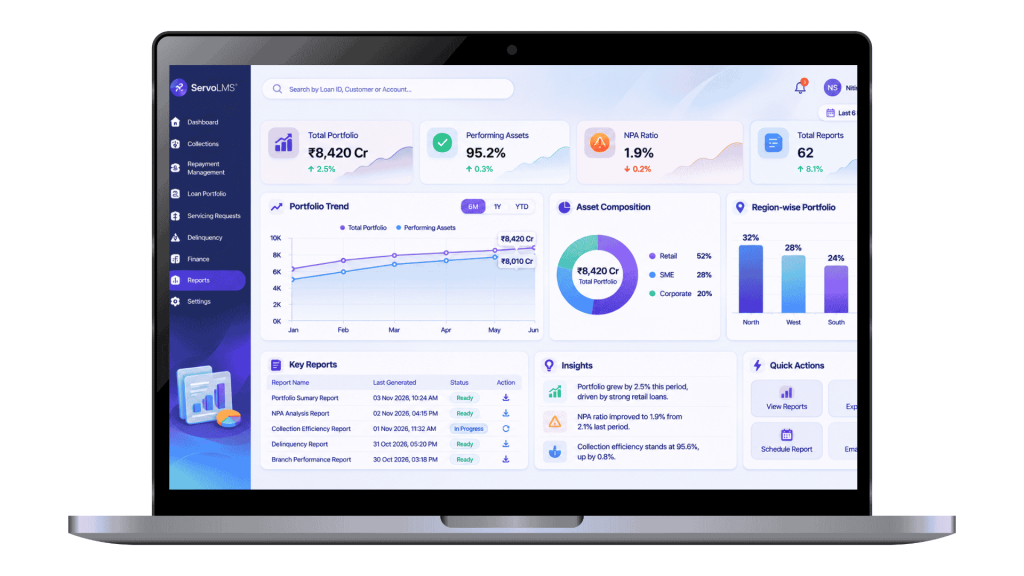
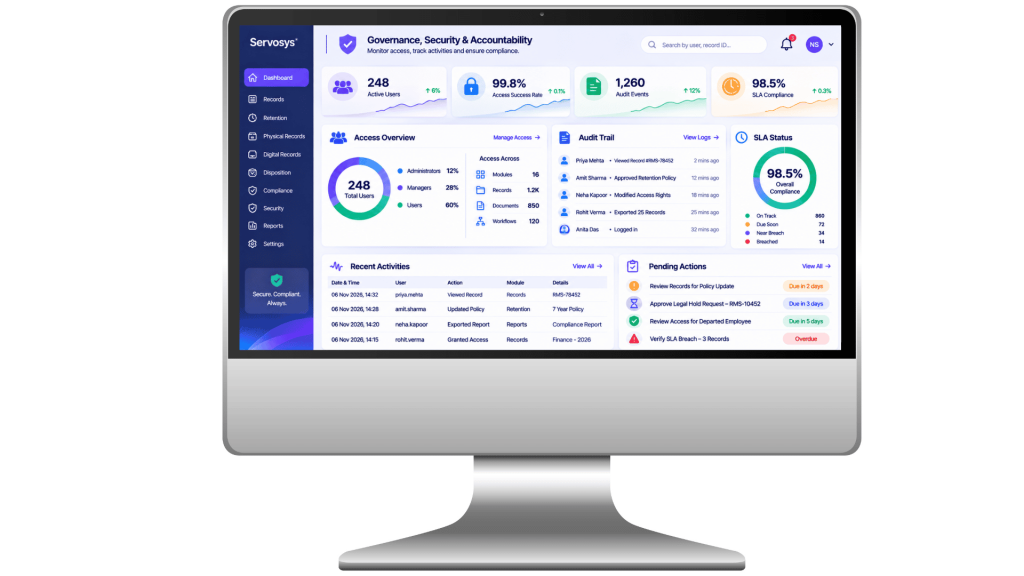
• Integrate records management system with DMS for electronic and hybrid record storage and viewing, and management.
• Enable full-text DMS search, metadata-based RMS retrieval, secure downloads, role-based access, notifications, and dashboards.
• Manage approved destruction, archival transfers, and reclassification through structured records management workflows.
• Support controlled destruction, witness verification where configured, destruction certificates and preservation of audit history.
• Enforce role-based access and permissions across users, modules, records, documents and workflows, with secure authentication.
• Track audit trails and SLA performance through dashboards showing pending, due, near-breach, and breached activities.
Maintain complete records, activity histories and traceable audit evidence for stronger audit and certification readiness.
Apply policy-based retention, authorized legal holds & controlled disposition through centralized records retention management.
Prevent premature destruction through authorized approvals, legal hold controls and consistent retention governance.
Track physical record movements, custody history, storage locations and retrieval activities through integrated tracking.
Improve record discovery through structured classification, efficient search capabilities and SLA-based retrieval visibility.
Strengthen responsibility with role-based access, controlled permissions and traceable audit trails across records operations.

We have evaluated various products, and we thought Servosys Solutions is one of the best we have come across. We were also looking for a partner who is much more helpful in terms of migrations or much faster TAT, the needs we asked for, or the requirement we raised. Servosys was equally efficient and good in that particular aspect. We have been using this product for 3 odd years, and overall, I am very impressed.
With Servosys’ records management system, gain complete visibility into your records lifecycle with controlled tracking, faster retrieval and audit-ready records.
A Records Management System (RMS) helps organizations manage records throughout their lifecycle, from creation and classification to storage, retrieval, retention and final disposition. It provides structured controls for record tracking, access, compliance and auditability.
An RMS can manage physical, electronic and hybrid records. It supports centralized classification, tracking, storage, retrieval and lifecycle governance across different record formats.
Banks and NBFCs handle large volumes of customer, financial, operational and compliance records. An RMS helps them maintain structured records, control access, track physical and digital records, enforce retention policies and maintain auditable activity histories.
An RMS can use QR-code identification for physical boxes and folders, along with printable coversheets, manifests and shipping labels. It also maintains movement history, warehouse receipt details, storage locations and chain-of-custody records.
Yes. An RMS can apply policy-based retention periods and calculate retention due dates. Authorized users can also place legal holds with mandatory reasons, preventing record disposition while the hold remains active.
Yes. An RMS can integrate with a DMS to support electronic and hybrid record storage and viewing. This integration also enables DMS-supported full-text search and controlled access to digital documents.
An RMS uses role-based permissions to control access across users, modules, records, documents and workflows. It also maintains audit trails that capture user activities, actions, timestamps and related record details.
An RMS supports controlled disposition actions such as destruction, archival transfer and reclassification. Depending on the configured process, it can include witness verification, generate destruction certificates and preserve the associated audit history.
Servosys Solutions is a unit of EML Consultancy Services Private Limited, a company headquartered in New Delhi, India. We are one of the fastest-growing providers of software products and technology services for business process automation solutions that address challenges like process turn-around time, organizational productivity, regulatory compliance, business scalability, operational visibility and excellence.
Adding {{itemName}} to cart
Added {{itemName}} to cart