
For years, banks have invested heavily in digitizing customer acquisition through modern Loan Origination Systems(LOS Systems), mobile applications, APIs, fintech partnerships, and digital marketplaces. Credit bureau reports can be fetched within seconds. Customers receive application acknowledgements almost instantly.
Yet despite these digital investments, many legacy LOS Systems still focus primarily on application capture rather than orchestrating the complete lending lifecycle.
Approvals remain delayed because applications move through multiple disconnected teams. Credit decisions vary across branches. Compliance checks are manually verified. Risk teams rely on spreadsheets for exceptions. Business heads lack real-time visibility into loan pipelines, while customers increasingly expect decisions in hours rather than days.
The problem is no longer digitization.
The problem is orchestration.
Banks have successfully digitized customer entry points, but many LOS Systems have not fundamentally redesigned the operational journey that follows. As lending portfolios become more diverse and regulations become more demanding, this gap between digital channels and operational execution is becoming increasingly expensive.
Today’s lending environment is significantly more complex than it was even five years ago.
A single institution may simultaneously manage retail lending, commercial lending, SME financing, housing loans, gold loans, agriculture finance, and specialized sectoral credit programs. Each lending product follows different underwriting principles, approval hierarchies, documentation requirements, regulatory obligations, and turnaround time expectations.
Yet many institutions continue to manage these vastly different lending products using fragmented workflows, disconnected legacy LOS Systems, and isolated point solutions.
The result is operational inconsistency.
Commercial lending often requires layered approvals involving credit committees, legal teams, and relationship managers. Retail lending demands high-volume, standardized decision-making with minimal turnaround time. Housing finance introduces extensive documentation, valuation, and legal verification, while gold lending prioritizes branch-level efficiency and rapid collateral assessment. MSME and agriculture lending bring their own complexities around cash-flow assessment, government schemes, and seasonal business cycles.
Although every lending business operates differently, they all depend on one common capability—structured loan origination.
This is precisely why leading institutions are modernizing their LOS Systems and investing in intelligent lending origination software that supports Commercial Loan Origination, Retail Loan Origination, Home Loan Processing, Gold Loan Management, MSME Lending, and Agriculture Finance through configurable workflows rather than isolated operational silos.
Modern LOS Systems also integrate with core banking platforms, credit bureaus, KYC providers, document management systems, and third-party APIs, enabling a connected lending ecosystem instead of disconnected point solutions.
Many banks continue investing in digital channels expecting faster lending outcomes.
However, customer acquisition is rarely the limiting factor anymore.
Operational execution is.
Applications frequently enter the organization through multiple channels, but then move across disconnected departments where manual interventions become unavoidable.
Operations teams chase incomplete documentation.
Credit officers apply policies differently.
Risk managers investigate exceptions without complete visibility.
Compliance teams reconstruct audit trails.
Senior management waits for static reports before identifying operational bottlenecks.
Every individual activity appears manageable.
Collectively, they create significant operational friction.
As lending volumes increase, these inefficiencies multiply rather than disappear.
This is why institutions often experience longer turnaround times despite significant investments in digital transformation.
Forward-looking banks are beginning to recognize that lending transformation is no longer about replacing paper with digital forms.
It is about creating intelligent workflows that orchestrate every participant involved in the lending lifecycle.
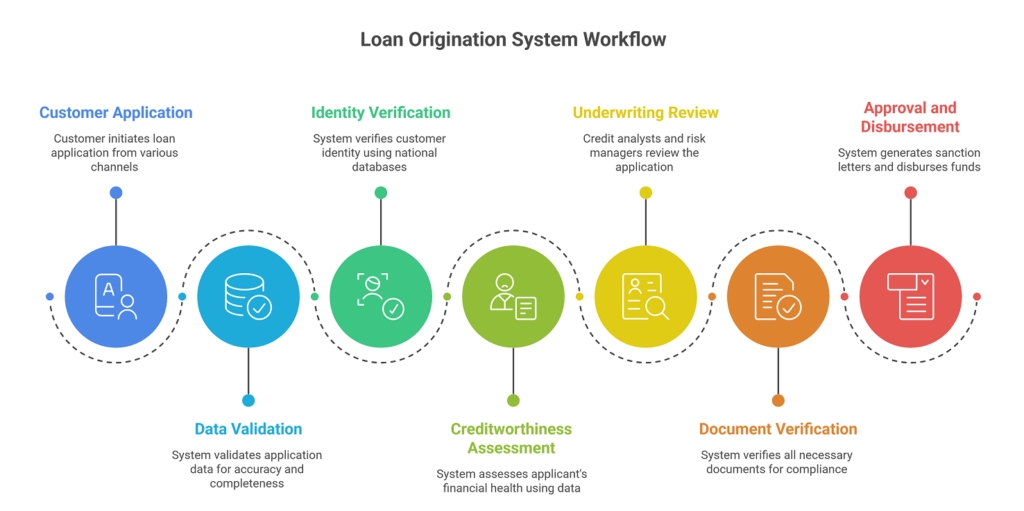
Modern LOS Systems have evolved beyond digital application capture into intelligent loan origination software that automates workflow routing, policy enforcement, compliance validation, and operational governance.
Instead of manually routing applications, workflow automation automatically move requests to the appropriate stakeholders.
Instead of relying on individual judgement, policy engines support intelligent credit decisioning while consistently enforcing lending policies.
Instead of discovering compliance issues during audits, validation occurs throughout the lending journey.
Instead of reviewing operational performance after month-end, leadership teams gain continuous visibility into lending operations.
Workflow intelligence transforms lending from a collection of isolated activities into an integrated loan processing ecosystem.
For low-risk lending scenarios, modern LOS Systems also enable Straight-Through Processing (STP), allowing eligible applications to move from submission to approval with minimal manual intervention while maintaining compliance and auditability.
This approach becomes even more valuable when institutions manage multiple lending portfolios simultaneously.
Whether the customer is applying for a commercial credit facility, a retail personal loan, a housing loan, an MSME working capital facility, or an agriculture loan, the underlying governance framework remains structured while individual workflows adapt to product-specific requirements.
Many transformation initiatives begin with technology selection.
The more successful ones begin with operational design.
Technology alone cannot eliminate fragmented decision-making, inconsistent policies, or manual coordination.
Modern LOS Systems deliver value when they combine technology with standardized lending processes, workflow automation, configurable business rules, and enterprise-wide governance.
Those improvements occur only when institutions redesign the way lending decisions move across people, policies, systems, and compliance frameworks.
A modern LOS System strategy should support the complete lending ecosystem—from commercial lending and retail finance to housing, MSME, gold, and agriculture portfolios—without forcing every business line into identical operating models.
Standardization where governance demands it.
Flexibility where business requires it.
That balance is becoming the defining characteristic of high-performing lending institutions.
Digital lending is entering its next phase.
Competitive advantage will no longer come from offering online applications alone. It will come from deploying intelligent LOS Systems, digital lending software, and lending origination software that orchestrate credit decisions, automate policy execution, strengthen compliance, and scale lending operations across multiple business lines.
Banks that continue treating lending as disconnected departmental activities will find it increasingly difficult to meet customer expectations, regulatory obligations, and growth objectives simultaneously.
Those that redesign loan origination using modern LOS Systems and workflow-driven operating models will be significantly better positioned to deliver faster decisions, stronger governance, and sustainable operational efficiency.
Because in modern banking, successful lending is no longer defined by how applications enter the organization.
It is defined by how intelligently LOS Systems orchestrate every step of the lending journey—from application to approval, compliance, disbursement, and beyond.
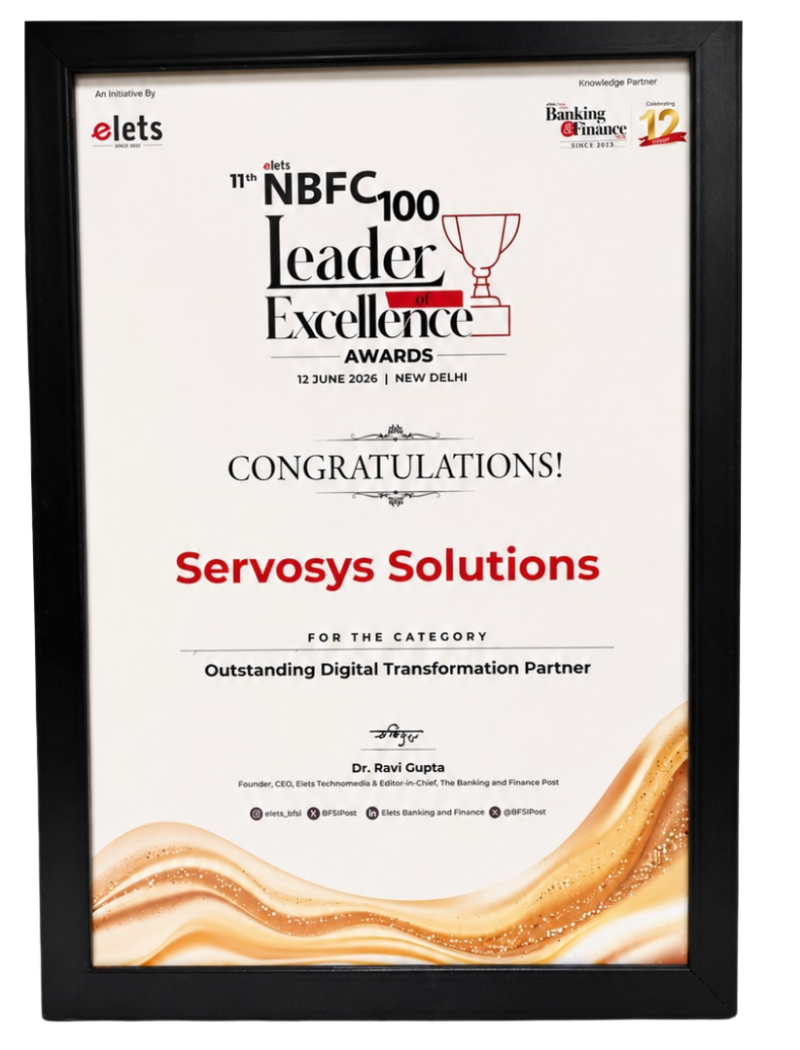
Servosys Solutions is a unit of EML Consultancy Services Private Limited, a company headquartered in New Delhi, India. We are one of the fastest-growing providers of software products and technology services for business process automation solutions that address challenges like process turn-around time, organizational productivity, regulatory compliance, business scalability, operational visibility and excellence.
Adding {{itemName}} to cart
Added {{itemName}} to cart