Every document has a lifecycle. While active documents drive daily operations, completed records must still be preserved as business evidence.
Managing this transition from active use to long-term retention is where many enterprises struggle. Document archiving addresses this gap by providing a systematic way to retain, protect, and retrieve records—without burdening operational systems or teams.
This guide explains what document archiving is, why it matters, how it works, and how enterprises can build a structured, secure, and future-ready archiving approach with an advanced document archiving system.

Document archiving is the structured way enterprises store inactive documents for long-term retention—while keeping them secure, searchable, and compliant with regulations.
Once a business process is complete, a document often turns into a record. It may not be used every day, but it still holds value as proof of a transaction, decision, or action taken at a specific point in time.
Common examples include:
Finalized contracts
Closed financial statements
Completed employee records
Approved policies and compliance reports
Document archiving ensures these records are preserved with integrity, protected from unauthorized access, and easy to retrieve when needed—for audits, legal reviews, or business reference.
As enterprises scale, documents multiply—across departments, systems, and formats. Without a structured archiving approach, records often end up scattered, duplicated, or stored indefinitely with little visibility.
Document archiving brings order to this chaos and delivers clear business value. Having said that, here’s what makes document archiving essential for enterprises:
Compliance and Risk Management
Many industries are governed by strict regulations that mandate how long records must be retained. Proper archiving ensures documents are tamper-proof, auditable, and readily available—reducing compliance risk and supporting regulatory readiness.
By separating active documents from archived records, teams reduce clutter in day-to-day systems. This allows employees to focus on current work while maintaining confidence that historical records are preserved and retrievable when required.
Digital archiving minimizes reliance on physical storage, reduces paper usage, and lowers administrative overhead associated with manual record handling and duplication.
Archived documents serve as an organization’s institutional memory, ensuring critical information remains accessible during audits, system disruptions, or organizational changes.
While closely related, document archiving and document management serve different purposes within the document lifecycle.
Document management focuses on active documents—creation, collaboration, approvals, and version control. Document archiving comes into play after a document has completed its active phase.
In enterprise environments, both functions work together. A modern Document Management System (DMS) manages documents throughout their lifecycle and automatically transitions completed documents into a secure archive based on defined rules and retention policies.
Physical Document Archiving
Physical archiving involves storing paper records in filing rooms, cabinets, or off-site facilities. While still necessary for certain original documents—such as notarized agreements or property titles—physical archiving is resource-intensive and difficult to scale.
Digital Document Archiving
Digital archiving stores documents electronically on secure servers or cloud platforms. Documents are indexed, protected, and made searchable, significantly improving accessibility and control.
Benefits of digital document archiving include:
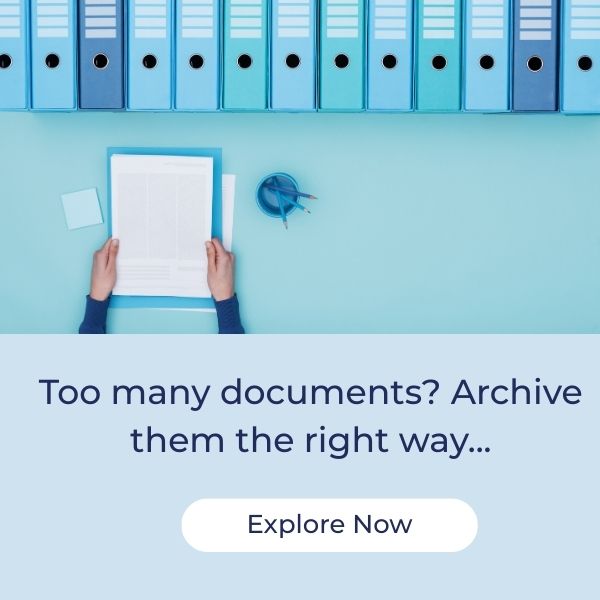

At its core, document archiving follows a clear and predictable journey. Once a document has served its purpose in daily operations, it moves into an archive where it’s preserved for long-term use.
Here’s what that journey usually looks like:
Document identification
First, the system determines when a document is no longer active and officially becomes a record that needs to be retained.
Classification and indexing
Next, the document is tagged with the right metadata so it can be quickly found later—without digging through folders or systems.
Retention enforcement
Retention rules are applied to ensure the document is stored for the correct duration, in line with business and regulatory requirements.
Secure storage
The record is then stored in a protected, tamper-proof repository to maintain its integrity over time.
Controlled access and retrieval
When needed—for audits, legal checks, or business reference—the document can be securely accessed by authorized users.
Modern document archiving systems handle most of this automatically, bringing consistency, compliance, and scalability to enterprise archiving—without adding manual effort for teams.
Building a strong document archiving strategy isn’t just about moving files out of active use. It requires a structured approach that helps organizations stay compliant, control storage costs, and ensure critical information remains accessible when needed.
A well-planned strategy simplifies document lifecycle management while protecting business records over the long term.
Before archiving begins, organizations need a clear view of their existing document landscape. Over time, documents spread across departments, systems, and storage locations, leading to duplication, inconsistency, and rising storage costs.
A comprehensive document audit brings order to this complexity by identifying:
By clearly separating documents based on their lifecycle stage, organizations reduce clutter, eliminate unnecessary storage, and ensure that only relevant records move into the archive—setting the foundation for a controlled and efficient archiving process.
Step 2: Establish a Document Retention Policy
Once documents are classified, retention rules must be defined. A document retention policy determines how long each category of document must be stored, based on regulatory mandates, industry standards, and internal governance requirements.
A well-defined retention schedule helps organizations:
More importantly, retention policies introduce consistency and accountability, ensuring that archiving decisions are policy-driven rather than manual or ad hoc.
Step 3: Choose the Right Archiving Approach
With governance in place, organizations must decide where and how archived records will be stored. There is no one-size-fits-all model—each enterprise must align its archiving approach with security, compliance, and operational needs.
Common approaches include:
We recommend organizations to finalize archiving method based on data sensitivity, compliance obligations, and business priorities.
For organizations transitioning away from paper-based records, digitization is a critical step toward modern archiving. Converting physical documents into digital formats improves accessibility, resilience, and long-term usability.
This step typically includes:
Together, these capabilities transform static files into structured, searchable records—making retrieval faster, audits smoother, and information easier to manage at scale.
Step 5: Implement Security and Compliance Controls
Archived documents often contain sensitive business and customer information, making security a top priority. Without proper safeguards, archived data can become a compliance risk.
Effective document archiving requires:
These safeguards ensure archived records remain tamper-proof, trustworthy, and audit-ready—preserving both data integrity and organizational confidence over the long term.
Step 6: Automate the Document Archiving Process
Manual archiving is not only time-consuming but also prone to human error. Automation helps ensure accuracy, consistency, and timely execution.
Modern document archiving systems support:

Enterprise document archiving doesn’t have to feel overwhelming—but it often does. High document volumes, unstructured files, multiple source systems, and tight compliance rules can quickly turn archiving into a headache. That’s exactly where ServoDocs steps in—by automating the entire journey from document creation to secure, searchable storage.
So, how does archiving work in ServoDocs?
Documents created across systems like ERP, CRM, LMS, or core banking platforms flow directly into ServoDocs through secure APIs. There’s no need for manual uploads or tedious classification. Indexing details and metadata are captured automatically the moment a document is ingested.
Once inside ServoDocs, documents are indexed using this metadata and stored in an encrypted repository. The result? Every record stays tamper-proof, easy to find, and audit-ready for its entire retention lifecycle.
ServoDocs Features That Enable Efficient Archiving…
ServoDocs combines intelligent automation with enterprise-grade controls to address common archival challenges:
Document archiving doesn’t have to be complicated. With the right approach, you can keep your records secure, easy to find, and fully compliant—while freeing your team from manual archiving tasks. With ServoDocs, you’ll explore faster retrieval, automated indexing, and enterprise-grade security—all in one seamless system.
Ready to simplify your document management journey?
FAQs on Document Archiving
Document archiving is the structured process of storing inactive documents for long-term retention while keeping them secure, searchable, and compliant with regulatory requirements. Once a document has completed its active business use, it becomes a record that must be preserved as evidence of decisions, transactions, or actions.
As organizations scale, document volumes grow across departments and systems, increasing the risk of data sprawl and compliance gaps. Document archiving helps enterprises maintain regulatory readiness by ensuring records are retained, protected, and retrievable for mandated periods.
Beyond compliance, archiving improves operational efficiency by separating active documents from historical records, reduces storage costs, and preserves organizational knowledge for long-term continuity.
Document archiving follows a structured lifecycle. Once a document is no longer actively used, it is identified as a record, classified, and indexed using metadata for easy retrieval. Retention rules are then applied to determine how long the document must be stored.
The archived record is stored in a secure, tamper-proof repository with controlled access. When required—for audits, legal checks, or reference—authorized users can retrieve the document quickly without impacting day-to-day operations.
Effective document archiving depends on a set of features that ensure records are stored securely, remain compliant, and can be retrieved easily over time. In enterprise environments, these features work together to manage large document volumes without manual effort or risk.
Key features that help in document archiving include:
Automated Archiving Rules: Automatically archive documents based on age, status, document type, or business events, reducing manual intervention and errors.
Retention Policy Management: Define and enforce retention schedules to ensure documents are stored for the required duration and disposed of in line with regulatory and business policies.
Metadata Indexing and Classification: Capture metadata such as document type, date, department, and reference IDs to make archived records easy to search and retrieve.
Secure, Tamper-Proof Storage: Protect archived documents using encryption and write-once or immutable storage to preserve data integrity over long retention periods.
Role-Based Access Control (RBAC): Restrict access to archived records so only authorized users can view, retrieve, or manage sensitive documents.
Audit Trails and Activity Logs: Maintain a complete record of who accessed, modified, or retrieved documents—critical for audits, investigations, and compliance reporting.
Fast Search and Retrieval: Enable quick access to archived documents using metadata, full-text search, or filters, without impacting active business systems.
Integration with Enterprise Systems: Seamlessly archive documents from ERP, CRM, HRMS, core banking, and other systems through APIs or connectors.
Scalability and Long-Term Preservation: Support growing document volumes and long retention periods without performance degradation or rising operational complexity.
Together, these features ensure document archiving is not just about storage, but about compliance, security, accessibility, and long-term business continuity—making archiving a reliable extension of the enterprise document lifecycle.
ServoDocs automates document archiving by integrating directly with enterprise systems such as ERP, CRM, and core banking platforms. Documents flow into ServoDocs through secure APIs, where metadata is captured automatically at ingestion.
Once archived, records are stored in an encrypted repository with role-based access, audit trails, and policy-driven retention—ensuring documents remain searchable, compliant, and audit-ready throughout their lifecycle.
Innovate, simplify, and expand with cutting-edge process automation solution.
Servosys Solutions is a unit of EML Consultancy Services Private Limited, a company headquartered in New Delhi, India. We are one of the fastest-growing providers of software products and technology services for business process automation solutions that address challenges like process turn-around time, organizational productivity, regulatory compliance, business scalability, operational visibility and excellence.
Adding {{itemName}} to cart
Added {{itemName}} to cart