For banks and NBFCs, selecting a lending technology platform is no longer just an IT decision—it’s a strategic one. As lending operations expand across products, channels, and customer segments, most CXOs are faced with a crowded vendor landscape, each promising speed, automation, and scalability.
However, the real challenge lies in separating essential capabilities from feature overload. Many institutions invest in systems that appear comprehensive on the surface but fail to deliver long-term flexibility, integration, or measurable business impact.
This is where a structured evaluation becomes critical. While most platforms build on a core loan origination system, modern lending demands a broader approach—one that supports end-to-end orchestration, intelligent decisioning, and scalable operations.
This blog outlines a CXO-focused checklist to help you identify the loan origination system features that actually matter!
A common mistake in technology selection is evaluating platforms based on the number of features rather than their business impact.
At a surface level, most lending systems offer similar functionalities—application capture, workflow automation, and document management. However, the real difference lies in how these features translate into operational efficiency, risk control, and scalability.
It is important to distinguish between:
As a CXO, your focus should be on outcomes. Your lending origination system should not just automate processes; it should enable better decisions, faster growth, and stronger risk management.
Your lending solution should not just automate processes—it should enable you to scale operations, improve decision-making, and maintain control as complexity increases.
The following capabilities are critical in that evaluation:
Your lending origination software should support the complete lifecycle—from application intake to final disbursement—within a single, unified workflow.
As your lending portfolio expands across products, your teams should not have to rely on disconnected systems or manual handoffs. Instead, your solution should allow you to configure workflows, standardize processes, and manage multiple lending products without operational friction.
This becomes particularly important as you scale, where consistency and visibility directly impact turnaround time and efficiency.
Your ability to grow sustainably depends on how effectively you manage credit risk. Your lending origination solution should enable you to define and enforce credit policies through rule engines, scorecards, and automated underwriting.
It should also allow you to integrate seamlessly with credit bureaus and alternative data sources, giving you access to real-time insights during decision-making. As your lending volumes increase, your system should help you maintain consistency in decisions while improving speed—without compromising on risk controls.
3. Integration and Technology Architecture
Your lending ecosystem is only as strong as its ability to connect. Your lending software should be built on an API-first architecture that allows you to integrate easily with your existing core systems and third-party services.
Whether its KYC providers, payment gateways, or external data sources, your solution should fit into your technology landscape without creating silos. As your organization evolves, your system should adapt with you—supporting new integrations, channels, and business models without requiring major rework.
4. Customer Experience Capabilities
Your customers expect fast, transparent, and digital-first interactions. Your lending origination system should enable you to deliver consistent experiences across branches, mobile apps, web platforms, and partner channels.
From digital onboarding and real-time verification to application tracking, your solution should reduce friction at every stage of the borrower journey. This will not just enhance their experience but directly impacts your conversion rates and overall lending performance.
5. Operational Efficiency and Processing
As your lending operations scale, efficiency becomes a key differentiator. Your lending origination software should minimize manual intervention through automation, enabling straight-through processing wherever possible.
Capabilities such as centralized document management, OCR-based data capture, and streamlined processing workflows help reduce operational overhead.
At the same time, your system should allow you to handle exceptions in a structured manner, ensuring that non-standard cases do not disrupt your overall operations.
6. Analytics and Reporting
Your decision-making is only as strong as your visibility. Your lending origination solution should provide you with real-time insights into your lending pipeline, operational performance, and portfolio quality.
From tracking turnaround times and approval rates to identifying bottlenecks, your solution should enable continuous optimization.
As your business grows, advanced analytics should help you anticipate risks, monitor trends, and make more informed strategic decisions.
When evaluating a lending origination system, the real differentiator is not the number of features—but how those capabilities translate into measurable business impact for your organization.
Your focus should be on prioritizing what directly improves speed, control, scalability, and risk management. Instead of treating all features equally, your evaluation should reflect your strategic priorities and operating model.
A structured approach can help you align capabilities with outcomes:
Feature Category | Key Capability | Business Impact | Priority |
Workflow | End-to-end automation | Faster turnaround time | High |
Decisioning | Rule engine and scoring | Improved risk control | High |
Integration | API-first architecture | Scalability and flexibility | High |
Customer Experience | Omni-channel support | Higher conversions | Medium |
Operations | STP and document management | Cost reduction | High |
Analytics | Real-time insights | Better decision-making | Medium |
As you assess different platforms, your lending origination system should deliver strongly across high-priority areas without compromising flexibility in others. This approach ensures that your decision is driven by outcomes, not just feature comparison.
Even with a structured evaluation framework, certain missteps can limit the long-term value of your investment. Being aware of these early can help you make a more informed decision.
Prioritizing Feature Count Over Flexibility
A system with an extensive feature list may appear comprehensive, but if it lacks configurability, it can quickly become restrictive. Your lending origination system should adapt to your processes—not force you to change them.
Ignoring Integration Complexity
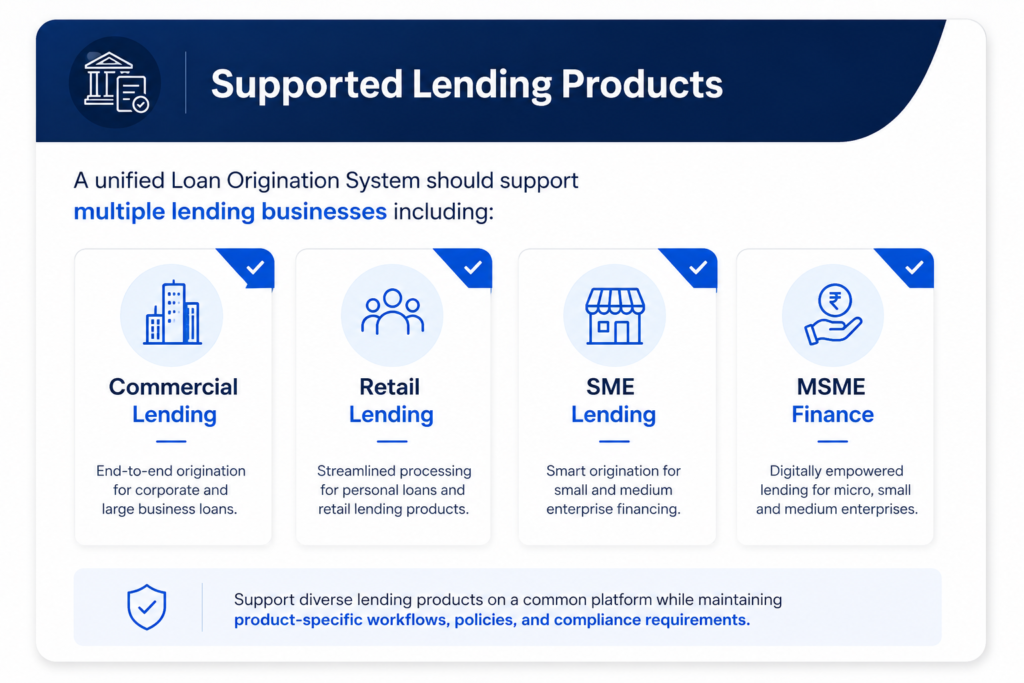
Whether you’re integrating workflows for Commercial Loan Origination, Retail Lending, SME Lending, or Gold Loans, your Loan Origination platform should connect seamlessly with your core banking system, credit bureaus, DMS, KYC providers, and third-party services.
Overlooking Scalability Requirements
What works for your current volumes may not support your future growth. Your lending origination solution should scale with your business—across products, geographies, and channels—without requiring frequent rework.
Underestimating Change Management
Even the most advanced system will not deliver value without proper adoption. Your teams should be able to use and configure the system easily, without heavy reliance on IT.
Avoiding these pitfalls is as important as selecting the right capabilities.
A Simple CXO Evaluation Checklist
Before selecting a lending origination system, ask these questions:
✔ Does it automate the complete loan lifecycle?
✔ Can it support Straight-Through Processing?
✔ Does it include configurable business rules and credit decisioning?
✔ Can it integrate easily with your existing technology ecosystem?
✔ Does it leverage AI for document processing and fraud detection?
✔ Will it scale across products, branches, and lending channels?
✔ Does it provide real-time analytics for operational visibility?
If the answer to most of these questions is yes, you’re evaluating a platform designed for long-term growth—not just short-term automation.
A loan origination system should not be evaluated as a standalone technology investment—it should be viewed as a strategic platform that supports how you plan to scale, compete, and manage risk.
Your lending operations are becoming increasingly complex, spanning multiple products, channels, and customer segments. To manage this effectively, your system should bring together workflows, decisioning, integrations, and analytics into a unified, scalable environment.
As a CXO, your focus should remain on long-term value creation. The right lending origination system will not just improve operational efficiency—it will strengthen your ability to make faster decisions, manage risk proactively, and deliver better customer experiences.
Ultimately, your choice should align with where you want your lending business to go—not just where it stands today.
FAQs on Loan Origination System
A lending origination system is a platform that manages the end-to-end loan lifecycle—from application and onboarding to credit decisioning and disbursement. It helps banks and NBFCs automate workflows, improve decision-making, and scale lending operations across products and channels.
Key features of a lending origination system include:
These features enable faster approvals, better risk control, and improved operational efficiency
A loan origination system typically focuses on digitizing the loan application and approval process. A lending origination system extends this by enabling multi-product lending, advanced decisioning, deeper integrations, and end-to-end orchestration across the lending lifecycle.
Banks and NBFCs need a lending origination system to:
It acts as a strategic platform for managing growth and complexity in modern lending.
To choose the right lending origination system, evaluate:
The right system should align with your business strategy and growth plans.
Innovate, simplify, and expand with cutting-edge process automation solution.
Servosys Solutions is a unit of EML Consultancy Services Private Limited, a company headquartered in New Delhi, India. We are one of the fastest-growing providers of software products and technology services for business process automation solutions that address challenges like process turn-around time, organizational productivity, regulatory compliance, business scalability, operational visibility and excellence.
Adding {{itemName}} to cart
Added {{itemName}} to cart