
Lending has always been a business where speed, accuracy, and control need to work together. However, as financial institutions expand their lending portfolios, introduce new products, and serve increasingly digital customers, managing these expectations through traditional processes becomes more challenging.
Many banks and NBFCs still operate with a combination of manual activities, disconnected systems, and complex approval processes. While these processes may support existing operations, they often create bottlenecks when institutions need to scale.
Loan processing delays, limited visibility into application journeys, and operational dependencies can directly impact customer experience and business efficiency.
The question financial institutions need to consider is: How can lenders improve operational efficiency while maintaining better control over lending decisions and customer experiences?
A modern digital loan origination system provides a structured approach to addressing these challenges by connecting loan origination, decision-making, workflow automation, and collections processes into a more efficient lending ecosystem.
For many lenders, the challenge is not simply managing more loan applications. It is managing increasing complexity across the entire lending process.
Every loan journey involves multiple stages — application submission, document verification, credit assessment, approvals, disbursement, and repayment management.
When these stages depend heavily on manual coordination, even small delays can impact overall turnaround time.
Based on our BFSI experience, we see Financial institutions commonly face challenges such as:
Over time, these operational gaps make it harder for lenders to deliver consistent borrower experiences while maintaining internal efficiency. This is where the need for a more connected and automated approach becomes important.
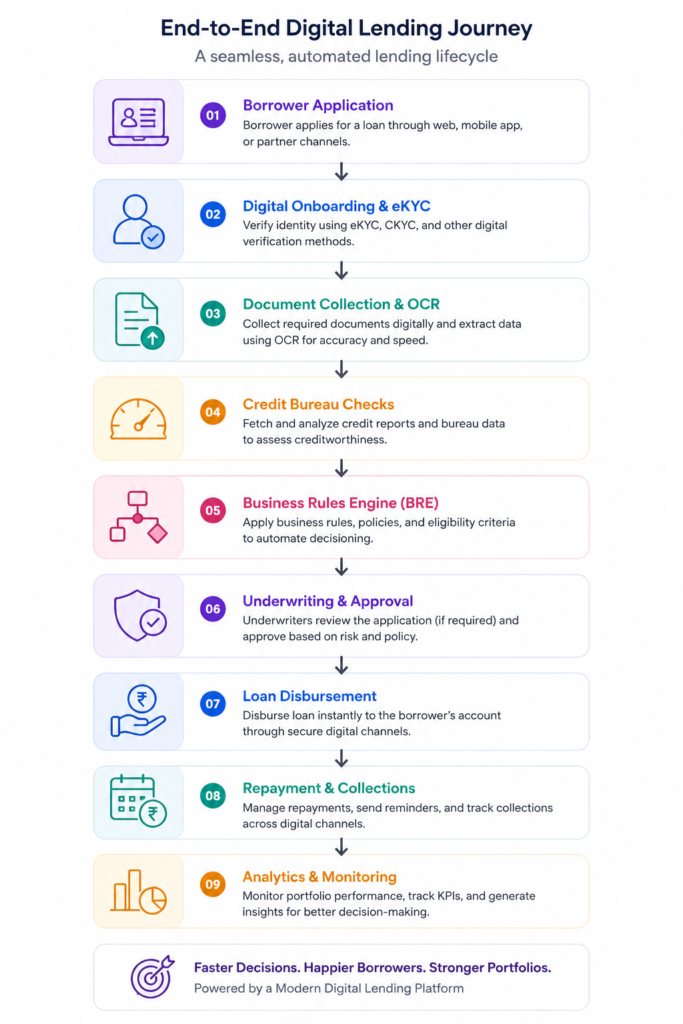
Note: While the exact workflow may vary across institutions, the objective remains the same—reducing manual effort, improving decision accuracy, and accelerating loan turnaround time.
A digital lending platform enables financial institutions to automate critical lending activities while improving visibility and control across the lending lifecycle.
The value comes from bringing different processes together instead of managing each activity separately.
The origination stage plays a significant role in determining the speed and quality of the lending journey.
A modern loan origination system helps lenders manage the complete application lifecycle — from customer onboarding to approval.
It enables:
The benefit goes beyond reducing manual work. A well-designed LOS helps lenders create predictable and transparent processes where teams have better visibility into every application stage.
Credit decisioning is one of the most critical parts of lending operations. Financial institutions need to evaluate applications quickly while ensuring decisions align with internal policies.
A digital lending platform with automated decisioning capabilities helps lenders achieve this balance.
Capabilities such as:
..Support more consistent evaluations.
With loan origination system for underwriting, lenders can reduce dependency on manual reviews while improving decision accuracy and operational efficiency.
Every financial institution has unique lending policies, approval structures, and operational requirements. This is why flexibility becomes an important consideration when selecting a platform.
Lending workflow automation empowers lenders to configure processes based on their business needs instead of relying on fixed workflows.
This allows institutions to:
The Result? You establish lending operations that can adapt as business requirements change.
The lending journey continues beyond approval and disbursement. Effective repayment management plays a critical role in maintaining portfolio performance.
Integrated collections management capabilities help lenders bring more structure and automation to repayment processes.
This includes:
By improving collections processes, lenders can move toward a more proactive approach rather than relying only on manual follow-ups.
| Benefit | Business Impact |
|---|---|
| Faster loan approvals | Reduced turnaround time (TAT) |
| Workflow automation | Lower operational costs |
| BRE-powered decisioning | Consistent credit decisions |
| Digital onboarding | Better borrower experience |
| Real-time dashboards | Greater operational visibility |
| API integrations | Connected lending ecosystem |
| Scalable architecture | Faster launch of new loan products |
| Automated collections | Improved repayment efficiency |
Selecting a digital lending platform requires looking beyond individual features. The right solution should align with your lending processes, integrate with your existing technology ecosystem, and support future business growth. Here are some of the most important factors to evaluate:
No two financial institutions follow the same lending process. Look for a platform that allows you to configure loan journeys, approval hierarchies, business rules, and product-specific workflows without extensive custom development.
A digital lending platform should integrate seamlessly with core banking systems (CBS), CRM platforms, Loan Management Systems (LMS), credit bureaus, payment gateways, document management systems, and third-party services through secure APIs. Strong integration capabilities eliminate data silos and create a connected lending ecosystem.
Evaluate whether the platform includes a configurable Business Rules Engine (BRE), automated eligibility checks, credit bureau integrations, and support for policy-based underwriting. These capabilities help lenders improve decision consistency while reducing manual intervention.
Operational visibility is critical for managing lending performance. The platform should provide dashboards that track application status, turnaround time (TAT), approval ratios, bottlenecks, SLA adherence, and portfolio performance, enabling data-driven decision-making.
Your lending platform should support increasing application volumes, new loan products, additional branches, and changing regulatory requirements without requiring major system changes. Scalability ensures the platform continues to deliver value as your business evolves.
Banks and NBFCs operate in a highly regulated environment. Look for capabilities such as audit trails, role-based access control, maker-checker workflows, data encryption, and compliance with applicable RBI guidelines and internal governance requirements.
Modern digital lending platforms should support AI-powered document processing, workflow automation, low-code configuration, open APIs, and cloud deployment options. These capabilities make it easier to adapt to evolving customer expectations, regulatory changes, and new lending products.
| Evaluation Criteria | Why It Matters |
|---|---|
| Configurable workflows | Adapts to different loan products and approval processes |
| Business Rules Engine (BRE) | Enables consistent, policy-driven lending decisions |
| API integrations | Connects with CBS, LMS, CRM, credit bureaus, and third-party services |
| Workflow automation | Reduces manual effort and improves productivity |
| Analytics & dashboards | Provides real-time visibility into lending operations |
| Security & compliance | Supports audit trails, role-based access, and governance |
| Scalability | Supports business growth and increasing loan volumes |
| AI capabilities | Improves document processing, underwriting, and fraud detection |
At Servosys, we help banks, NBFCs, and financial institutions streamline lending operations with a configurable digital lending platform designed to support origination, decisioning, workflow automation, and collections.
With capabilities such as BRE-powered decisioning, BPMN 2.0 compliant process design, document management, and integration capabilities, we enable lenders to simplify complex processes, improve operational visibility, and build scalable lending journeys.
By helping financial institutions manage critical lending activities — from application processing and approvals to collections management — Servosys enables teams to reduce process complexity, strengthen operational control, and deliver better borrower experiences.
For us, modern lending is not just about adopting technology; it is about creating flexible, efficient processes that help lenders adapt to evolving business needs and scale with confidence.
Explore how Servosys can help transform your lending operations.
Servosys Solutions is a unit of EML Consultancy Services Private Limited, a company headquartered in New Delhi, India. We are one of the fastest-growing providers of software products and technology services for business process automation solutions that address challenges like process turn-around time, organizational productivity, regulatory compliance, business scalability, operational visibility and excellence.
Adding {{itemName}} to cart
Added {{itemName}} to cart