In large organizations, documents quietly power everything. Contracts keep revenue flowing, compliance records protect the business, engineering drawings guide production, and internal policies keep teams aligned. When documents are accurate and accessible, work moves forward smoothly.
But as enterprises grow, document management often becomes messy. Multiple versions of the same file start circulating. Documents live in disconnected systems. Approvals slow down. Visibility drops. And suddenly, something as simple as a missing or outdated document can delay a project, create compliance risks, or even stop operations altogether.
Enterprise Document Management (EDM) addresses these challenges by transforming how enterprises manage documents. EDM brings structure, control, and intelligence to how documents are handled—helping enterprises reduce risk, improve collaboration, and operate with confidence at scale.
In this guide, we’ll walk through what Enterprise Document Management really means, why it matters, how it works, and the tangible benefits organizations see when they adopt an enterprise-grade document management software.
Enterprise Document Management (EDM) is a structured way for organizations to create, capture, organize, store, manage, and retrieve documents—across teams, departments, and locations. Unlike basic file storage tools, EDM is built for scale, governance, security, and compliance.
An enterprise document management system automates document-heavy activities like classification, version control, approvals, and retention. It also helps enforce compliance by tracking who accessed what, when changes were made, and how documents are secured—so nothing slips through the cracks.
A Document Management System (DMS) is a key component within the broader EDM framework. Organizations can deploy DMS platforms in different ways depending on their security, scalability, and operational requirements.
Let’s have a look at three major DMS software types:
On-premise DMS solutions store documents on servers hosted within the organization’s infrastructure. This model provides maximum control over data security and is often preferred by enterprises with strict regulatory or data residency requirements.
However, note that on premise systems may involve higher upfront costs and require dedicated IT resources for maintenance and upgrades.
Cloud-based DMS platforms store documents on third-party servers and provide access via the internet. These systems are best if an enterprise’s priority areas include flexibility, scalability, and faster deployment with lower initial investment.
Cloud DMS solutions are well-suited for organizations seeking agility, remote accessibility, and reduced IT overhead while maintaining robust document control.
Hybrid DMS solutions combine the security of on-premise infrastructure with the scalability and accessibility of cloud platforms. Sensitive documents can remain on-premise, while less critical files are managed in the cloud.
This approach is ideal for enterprises balancing strict security requirements with modern collaboration needs.
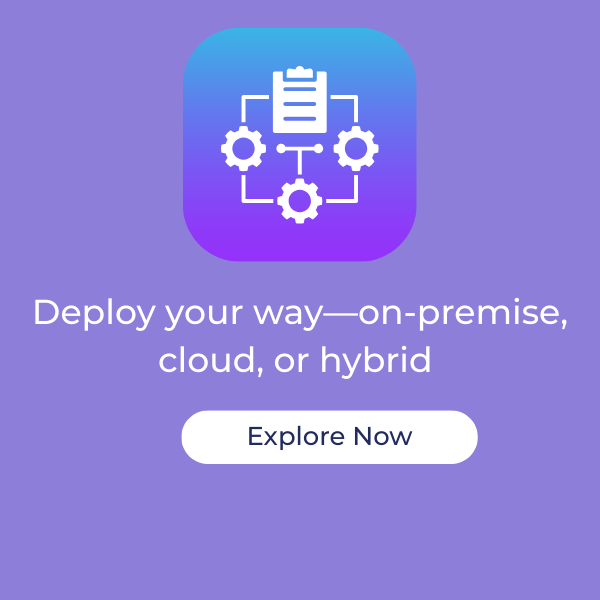

Not all document management platforms are built for enterprise use. An enterprise-grade document management solution includes advanced features designed to handle large volumes of documents, complex workflows, and stringent compliance requirements.
Together, these capabilities support complete document lifecycle management—from creation and collaboration to retention, archiving, and secure disposal.
A centralized repository stores all organizational documents in a single, secure location. This eliminates fragmented storage across multiple systems and creates a single source of truth. With advanced indexing and metadata, users can quickly locate documents using keywords, filters, or contextual search.
Version control tracks every change made to a document, ensuring teams always work with the most current version. Most EDMS Software allow teams to retain previous versions for reference or auditing, reducing errors caused by outdated information and improving document integrity.
Enterprise DMS platforms use role-based access controls to restrict document visibility and editing rights. Permissions can be customized based on roles, departments, or projects, protecting sensitive information and ensuring data governance.
Workflow automation capabilities of DMS software allow teams to automate document-centric processes such as approvals, reviews, and notifications. By eliminating manual handoffs, enterprises can reduce delays, minimize errors, and accelerate decision-making.
An enterprise DMS integrates seamlessly with systems such as ERP, CRM, HR, and BPM platforms. These integrations prove helpful especially when you want automatic data exchange, reduce duplication, and provide a unified view of organizational information.
Document Security and Compliance Management
Advanced security/compliance features such as encryption, audit trails, and compliance monitoring are a must to ensure documents meet internal policies and regulatory requirements. These capabilities form the foundation of effective document governance, ensuring documents are created, accessed, retained, and disposed of in line with internal policies and regulatory mandates.
Read More: Key Features of an AI-powered Document Management System
Implementing an EDMS Software offers several benefits to organizations such as:
As paper prices rise, the hidden expenses of manual document handling continue to grow. An electronic document management (EDM) system helps cut costs linked to misplaced files, compliance penalties, excessive paper usage, and data entry mistakes. According to CPA Practice Advisor, adopting EDM can reduce overhead by 30–40%, supporting long-term profitability and business growth.
Fragmented, manual workflows slow teams down. By digitizing critical documents using an AI- and OCR-enabled DMS, organizations can automate reviews, approvals, and storage—creating smoother, more efficient processes. This approach also enables controlled access, detailed audit trails, centralized repositories, and faster turnaround times.
A cloud-based DMS simplifies document sharing and collaboration for both in-office and remote teams. Files can be securely shared through controlled links, while version tracking and audit logs record edits and user activity. Integrated email capture ensures all related communication remains linked to the document.
A modern DMS captures and indexes documents with rich metadata, enabling powerful search across files and connected systems such as ERP. Users can quickly locate specific data or content, saving teams significant time and effort during day-to-day operations.
Moving to a cloud-enabled DMS removes the need for physical storage like filing cabinets and boxes. By supporting paperless, automated workflows, organizations free up office space and redirect storage-related costs toward higher-value initiatives.
Easier Retrieval
Document retrieval becomes faster and more intuitive with a digital DMS. Structured indexing and classification allow users to find files in seconds—addressing the significant time employees typically spend searching for information.
A DMS strengthens data protection with features such as role-based access, encryption, audit logs, and multi-factor authentication. Capabilities like automated backups, retention policies, redaction, and secure archiving help safeguard sensitive information and reduce cyber risk.
With cloud-based backups, a DMS ensures critical documents remain accessible even during system failures or unexpected disruptions. This built-in resilience supports business continuity and faster recovery in the event of data loss or infrastructure damage.
Enterprise Document Management supports a wide range of real-world scenarios across industries.
In engineering-driven environments, EDM systems manage drawings, schematics, specifications, and change requests. Version control and audit trails ensure accuracy while supporting compliance and quality standards.
Highly regulated industries rely on EDM to maintain audit readiness. Document traceability, retention policies, and access logs help organizations respond quickly to audits and regulatory reviews.
EDM also plays a role in preserving institutional knowledge. By organizing policies, procedures, and historical records, enterprises can ensure critical knowledge remains accessible even as teams evolve.
The future of enterprise document management is being shaped by AI, automation, and intelligent data extraction.
According to industry studies, organizations using AI-driven document management can reduce document processing time by 30–50%, while automated workflows cut approval cycles by up to 60%.
Intelligent document systems are increasingly capable of classifying content, extracting insights, and predicting compliance risks—transforming documents from static files into actionable business assets.
As enterprises continue their digital transformation, document management systems will evolve into intelligent information platforms. Cloud-native architectures, API-led integrations, and embedded analytics will enable real-time decision-making and enterprise-wide visibility.
With global data volumes expected to grow exponentially, enterprises that invest early in scalable, AI-enabled EDM solutions will gain a clear advantage in agility, compliance readiness, and operational efficiency.
Enterprise Document Management is no longer optional for modern organizations. As document volumes grow and compliance requirements tighten, enterprises need structured, secure, and scalable systems to manage information effectively.
By implementing an enterprise document management software, organizations improve productivity, enhance collaboration, reduce risk, and make better decisions. More importantly, they create a foundation for long-term operational efficiency and digital maturity.
For enterprises looking to modernize document handling, Enterprise Document Management is not just a solution—it is a strategic necessity.
At Servosys, our document management solution ServoDocs is already powering enterprises across industries with its AI and automation powered features.
FAQs on Enterprise Document Management
Enterprise Document Management (EDM) is a structured approach to creating, storing, managing, and governing documents across large organizations. It ensures documents are secure, searchable, version-controlled, and compliant with regulatory requirements while supporting collaboration at scale.
Basic document management focuses on storing and retrieving files, often for small teams. Enterprise document management goes further by adding governance, compliance controls, audit trails, workflow automation, integrations, and scalability required by large and regulated organizations.
A DMS is typically a component of a broader EDM strategy. While a DMS handles document storage and retrieval, an EDMS includes advanced capabilities such as governance, compliance management, integrations, workflow automation, and enterprise-wide scalability.
An enterprise document management system should include a centralized repository, document version control, role-based access, workflow automation, audit trails, compliance management, integration with ERP/CRM systems, and support for cloud, on-premise, or hybrid deployment.
Cloud-based document management offers scalability, faster deployment, and remote access, while on-premise systems provide maximum control and data residency. Many enterprises choose hybrid document management systems to balance security with flexibility.
By centralizing documents and automating workflows, an enterprise DMS reduces time spent searching for files, eliminates version confusion, and speeds up approvals. This enables teams to collaborate efficiently and focus on higher-value work.
Enterprise document management systems enforce compliance through access controls, automated retention policies, audit logs, and document traceability. These features help organizations meet regulatory requirements, stay audit-ready, and reduce compliance-related risks.
Yes. Enterprises using EDMS often reduce operational costs by minimizing paper usage, physical storage, manual processing, and rework. Automation and digitization typically lead to 25–40% cost savings in document-related operations.
Innovate, simplify, and expand with cutting-edge process automation solution.
Servosys Solutions is a unit of EML Consultancy Services Private Limited, a company headquartered in New Delhi, India. We are one of the fastest-growing providers of software products and technology services for business process automation solutions that address challenges like process turn-around time, organizational productivity, regulatory compliance, business scalability, operational visibility and excellence.
Adding {{itemName}} to cart
Added {{itemName}} to cart